
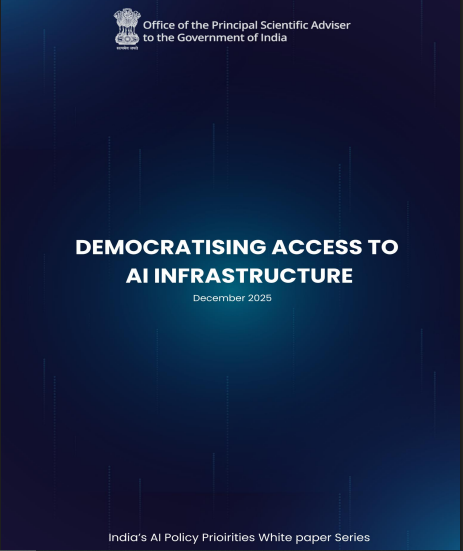
In its journey to govern AI, India has yet again released a new White Paper on AI Governance. The white paper is released by the Office of the Principal Scientific Adviser (PSA) to the Government of India on ‘Democratisising Access to AI Infrastructure’ on 29th December 2025. Released as part of India’s AI Policy Priorities White Paper Series, the document sets out a clear message: if AI is to truly drive inclusive innovation and economic growth, access to its foundational infrastructure must be broadened far beyond a few large firms and urban centres .
As AI becomes central to competitiveness, governance, and public service delivery, the White Paper recognises that control over compute power, datasets, and model ecosystems increasingly determines who can innovate and who cannot. Today, these resources are heavily concentrated globally in a handful of technology companies and geographically in major cities. This concentration, the paper argues, risks excluding smaller startups, academic institutions, state governments, and innovators working in local and regional contexts.
AI Infrastructure as a Public Enabler
At the heart of the White Paper is a simple but powerful idea: AI infrastructure should be treated as a shared national resource rather than a purely proprietary asset. Democratising access, in this sense, means making compute, data, and AI tools available, affordable, and usable for a wide range of actors—researchers, startups, public institutions, and community innovators alike.
The document defines AI infrastructure broadly. It includes physical components such as data centres, high-performance computing clusters, GPUs and TPUs, as well as digital layers like datasets, model repositories, and platforms that enable training, testing, and deployment of AI systems. Without access to these layers, even the most talented innovators are effectively locked out of meaningful participation in the AI ecosystem.
The White Paper highlights that India already generates and hosts nearly 20% of the world’s data, yet accounts for only about 3% of global data centre capacity. This mismatch underscores a structural vulnerability: without sufficient domestic and accessible infrastructure, India risks becoming dependent on foreign cloud providers for critical AI workloads. Democratising access is therefore framed not only as an inclusion issue, but also as one of technological sovereignty and long-term resilience.
Three Enablers for Democratic Access
Aligned with India’s AI governance vision, the White Paper identifies three key enablers that must work together to expand access.
The first is expanding access to high-quality, representative datasets. AI systems are only as good as the data they are trained on, and the lack of India-specific, multilingual, and contextually relevant datasets has long been a barrier to building solutions that work at scale for India’s diverse population. The paper points to initiatives such as IndiaAIKosh, Bhashini, and sectoral data platforms that aim to curate and share datasets across domains ranging from healthcare and agriculture to language and law.
Crucially, the emphasis is not just on openness, but on governance. Permission-based access models, data sovereignty, and privacy safeguards are highlighted as essential to building trust while enabling innovation. The goal is to strike a balance between usability and accountability.
The second enabler is providing affordable and reliable access to computing resources. Training and deploying modern AI models requires immense computational power, which is often prohibitively expensive for startups and research institutions. The White Paper notes the expansion of national GPU pools under the IndiaAI Mission and the availability of subsidised compute through unified portals. By lowering costs and reducing administrative friction, such platforms allow innovators in smaller cities and institutions without in-house infrastructure to participate meaningfully in AI development.
This “compute-as-a-service” approach is particularly important for enabling localisation—whether that means fine-tuning models for regional languages, local markets, or sector-specific applications.
The third enabler is integrating AI with India’s Digital Public Infrastructure (DPI). Building on the success of population-scale digital systems such as Aadhaar, UPI, and DigiLocker, the White Paper argues that DPI can serve as a coordination layer for AI access. Rather than creating a single monolithic AI platform, the document envisions modular, interoperable public-good layers that connect datasets, compute resources, and model ecosystems through common standards and governance frameworks.
Such an approach, the paper suggests, can lower entry barriers, reduce fragmentation, and ensure predictable access pathways for smaller players—while preserving competition and innovation in the broader market.
What India Has Built So Far
The White Paper also takes stock of India’s existing AI infrastructure landscape. On the physical side, it highlights the growth of data centres in hubs such as Mumbai, Chennai, Bengaluru, Hyderabad, and Delhi-NCR, supported by state-level policies that offer incentives, renewable energy mandates, and regulatory clarity. National initiatives like the National Supercomputing Mission and AI-dedicated systems such as PARAM Siddhi-AI and AIRAWAT demonstrate growing domestic capacity for high-performance computing.
On the digital side, platforms like IndiaAIKosh, Bhashini, and the Geospatial Data Sharing Interface illustrate how datasets and models can be shared at scale while retaining governance controls. State-led initiatives, such as Telangana’s data exchange model, are cited as examples of how federated, privacy-compliant data sharing can work without centralising raw data.
Challenges and Trade-offs
Importantly, the White Paper does not present democratisation as a frictionless process. It flags several challenges that must be addressed as access expands. Scaling AI infrastructure raises sustainability concerns, including energy consumption, cooling requirements, and land use. Data centres currently account for a small but growing share of India’s electricity consumption, a figure expected to rise sharply by 2030.
There are also governance risks. As access widens, ensuring cybersecurity, privacy protection, auditability, and clear accountability becomes more complex. Poorly designed access layers could inadvertently create new bottlenecks or exclude smaller institutions rather than empowering them. The document therefore stresses phased, modular implementation and sustained institutional capacity as prerequisites for success.
Why This Matters Now
The timing of the White Paper is significant. Globally, countries are racing to secure AI infrastructure as a strategic asset, with compute and data increasingly viewed as sources of geopolitical and economic power. Against this backdrop, India’s emphasis on democratisation offers an alternative framing—one that prioritises inclusion, public value, and local relevance alongside competitiveness.
For India, the stakes are high. If access remains concentrated, AI innovation risks becoming disconnected from the realities of India’s linguistic, cultural, and socio-economic diversity. If access is broadened thoughtfully, AI can become a tool for building local-language services, assistive technologies, sector-specific solutions, and public-interest applications that reflect India’s needs.
The White Paper does not claim to offer a finished policy blueprint. Instead, it positions itself as an explanatory and agenda-setting document one that invites further discussion, experimentation, and collaboration across government, industry, academia, and civil society. But its core message is clear: democratising AI infrastructure is no longer optional. It is a policy priority that will shape who gets to build, benefit from, and govern AI in India’s digital future.