
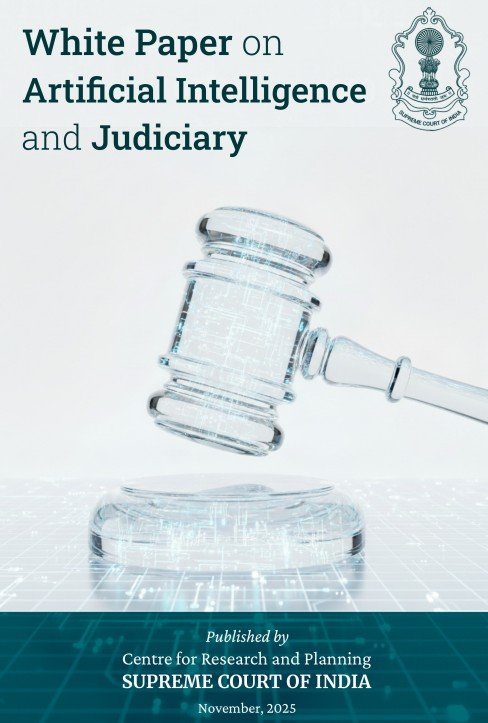
The Supreme Court of India, through its Centre for Research and Planning (CRP), has released a White Paper titled, “Artificial Intelligence and the Judiciary”, signaling a major shift towards technological innovation in justice delivery. This White Paper is a part of an important series of eight research papers published in November 2025, collectively aimed at advancing reforms to strengthen access to justice, enhance court efficiency, and ensure greater accountability within India’s judiciary.
The report recognizes the immense potential of AI in reshaping legal processes while reinforcing the need to safeguard constitutional values, procedural fairness, and fundamental rights.
The Role and Promise of Artificial Intelligence in Courts
The White Paper positions AI as a critical tool in addressing structural challenges that have long burdened the Indian judiciary. With over five crore cases pending across various courts in India, AI-assisted systems are viewed as essential in accelerating judicial workflows. The Supreme Court notes that AI technologies can facilitate smoother case management, reduce the workload on judges, expeditiously support legal research, and improve transparency in procedural operations.
Importantly, the Paper clearly asserts that AI should enhance—not replace—human decision-making. The primacy of judicial reasoning, discretion, and accountability remains non-negotiable.
India’s Emerging Judicial AI Ecosystem
India has proactively developed indigenous AI solutions tailored to the needs of its judicial institutions. These include:
- SUPACE – Enhancing Research Efficiency: The Supreme Court Portal for Assistance in Courts Efficiency supports judges through automated document extraction, case summarisation, and relevant legal reference identification.
- SUVAS – Promoting Linguistic Inclusivity: The Supreme Court Vidhik Anuvaad Software translates judgments into 19 Indian languages, supporting equitable access to legal information for non-English speaking litigants.
- TERES – Real-Time Courtroom Transcription: The Transcription of Electronic Record and Speech system provides real-time transcripts during Constitution Bench hearings, fostering transparency and improving archival processes.
- LegRAA – Generative AI for Legal Research : LegRAA is the Court’s own generative AI tool trained on Indian case law, designed to minimise reliance on commercial AI systems and ensure domain accuracy.
- AI-Enabled e-Filing System – Minimizing Procedural Errors: AI-driven defect-detection mechanisms in e-filing streamline submission scrutiny and reduce administrative bottlenecks.These innovations reflect India’s deliberate move toward self-reliance in justice-tech solutions.
Risks and Legal Vulnerabilities in AI Integration
The Supreme Court adopts a vigilant approach toward the risks involved, cautioning that premature or unchecked AI adoption could endanger judicial integrity. Key risks identified include:
- Accuracy Risks and Hallucinations: AI systems may produce non-existent case citations or incorrect legal interpretations, introducing misinformation into judicial reasoning.
- Deepfake Evidence Manipulation: Sophisticated synthetic media could distort oral and documentary evidence, destabilizing due process.
- Algorithmic Discrimination: Biases embedded in training datasets may reinforce social hierarchies and lead to discriminatory judicial outcomes.
- Data Protection and Confidentiality Concern: Feeding sensitive case data into non-secure or overseas AI systems could lead to breaches of privacy and judicial secrecy.
- Dependency Overreach: The risk of excessive trust in automated tools threatens human judgement and judicial independence.
Global Perspectives Informing India’s Approach
The White Paper situates India’s policy direction within a global regulatory landscape. It draws insights from:
EU AI Act: Structured risk-based compliance and oversight
Canada’s AIDA: Transparency obligations for governmental AI systems
Brazil’s Judicial AI: Regulated use of predictive systems
UK Judiciary Guidelines: Ethical guardrails for AI engagement in judicial contexts
This comparative review informs a calibrated adoption strategy anchored in judicial independence and constitutional propriety.
Ethical Framework and Guiding Principles
The Supreme Court articulates a set of foundational principles governing the use of AI in courts. These include:
The judge remains the final arbiter, with AI functioning as advisory support
Mandatory human verification of all AI outputs
Strict adherence to privacy, confidentiality, and data protection norms
AI’s role confined to processual and administrative functions
Clear disclosure whenever AI assists in any part of adjudication
These principles safeguard legitimacy, credibility, and public trust in justice outcomes.
Roadmap for Responsible AI Adoption in the Judiciary
The White Paper outlines a forward-looking strategy, proposing:
Establishment of AI Ethics Committees to oversee compliance and accountability
Investment in in-house, secure, and sovereign AI infrastructure
Standard operating guidelines for ethical AI usage and reporting obligations
AI training and capacity building for judges, lawyers, and court staff
Development of open-source and multilingual tools supporting equitable access
The focus remains on designing systems that enhance efficiency without compromising rights.
Conclusion: A Technology-Enabled Future Rooted in Constitutional Justice
This White Paper marks a defining moment in India’s ongoing pursuit of judicial modernization. It emphasizes that the judiciary is not merely adopting technology but reshaping the very architecture of justice delivery, ensuring that modernization aligns with human dignity and constitutional mandates.
India’s judiciary, serving a vast and diverse democracy, is uniquely positioned to influence global standards on responsible AI governance in legal systems. The Supreme Court’s message is unequivocal: AI will serve the ends of justice, not define them. Technology must remain an instrument of fairness, never a substitute for human wisdom.